Table of content
- Introduction
- What You Should Know
- Why This Matters
- Who Is Affected
- When This Becomes a Legal Issue
- Common Issues Involved
- Fault, Liability, and Insurance Considerations
- What to Do After a Motorcycle Accident
- How a Motorcycle Accident Lawyer Can Help
- Frequently Asked Questions
- Get a Free Consultation
- 150 Character Excerpt
- Instagram Caption
What Evidence Helps Strengthen a Motorcycle Accident Case?
Introduction
The moments immediately following a motorcycle accident are often chaotic.
Your adrenaline is high. You may be injured. Traffic is backing up, emergency responders are arriving, and your motorcycle is lying damaged in the roadway.
During this stressful time, it’s easy to overlook something that could become one of the most valuable parts of your case.
Evidence.
The strength of a motorcycle accident claim often depends on what can be proven, not simply what happened.
At Shark Law Motorcycle Attorneys, we’ve seen cases won because critical evidence was preserved early. We’ve also seen otherwise strong cases become more difficult because important evidence disappeared before it could be documented.
Founding Partner Robert Vetchtein explains, “The accident scene begins changing the moment the crash happens. Every minute that passes is an opportunity for evidence to disappear.”
Knowing what evidence matters can significantly improve your ability to recover the compensation you deserve.
What You Should Know
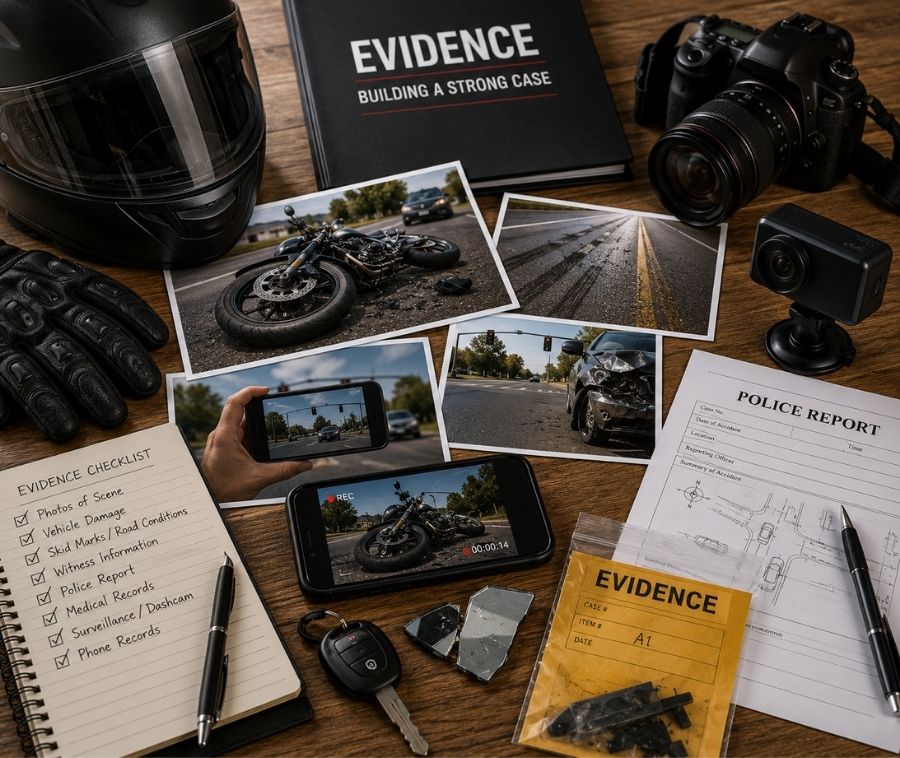
Evidence tells the story of your motorcycle accident.
It helps establish:
- How the crash occurred
- Who was responsible
- The severity of your injuries
- The financial impact of the accident
Insurance companies do not simply accept your version of events.
They compare police reports, witness statements, photographs, medical records, vehicle damage, and expert opinions before evaluating your claim.
The stronger your evidence, the stronger your position.
Why This Matters
Motorcycle accidents often happen quickly.
Drivers frequently say:
- “I never saw the motorcycle.”
- “The rider was speeding.”
- “They came out of nowhere.”
Without strong evidence, these statements can create unnecessary disputes about fault.
Robert Vetchtein explains, “Evidence removes guesswork. Instead of relying on opinions, we rely on facts.”
Collecting evidence early can make negotiations smoother and significantly strengthen your case if litigation becomes necessary.
Who Is Affected
Every injured rider benefits from preserving evidence.
This includes accidents involving:
- Left-turn collisions
- Lane splitting
- Rear-end crashes
- Road hazards
- Distracted drivers
- Drunk drivers
- Commercial vehicles
- Hit-and-run drivers
Even low-speed motorcycle accidents deserve thorough documentation because injuries often worsen over time.
When This Becomes a Legal Issue
Evidence becomes especially important when:
- Fault is disputed
- There are conflicting witness statements
- The insurance company denies responsibility
- Serious injuries are involved
- Multiple vehicles are involved
The burden of proof generally falls on the injured rider.
The better your documentation, the more difficult it becomes for an insurance company to dispute your claim.
Common Issues Involved
Causes
Several factors can weaken an otherwise strong motorcycle accident claim.
These include:
- Waiting too long to photograph the accident scene
- Losing damaged riding gear
- Repairing the motorcycle before documentation
- Failing to identify witnesses
- Delaying medical treatment
Each of these mistakes can remove valuable evidence.
Injuries
Medical evidence is equally important.
Common injuries include:
- Traumatic brain injuries
- Broken bones
- Internal injuries
- Road rash
- Neck injuries
- Back injuries
- PTSD
Your medical records help connect these injuries directly to the accident.
Fault, Liability, and Insurance Considerations
Insurance companies evaluate every claim based on evidence.
Some of the most valuable evidence includes:
Police Report
An official accident report often contains:
- Initial observations
- Driver statements
- Witness information
- Road conditions
- Possible citations
Photographs
Take photographs of:
- The entire accident scene
- Vehicle positions
- Motorcycle damage
- Road conditions
- Skid marks
- Debris
- Traffic signals
- Your injuries
- Your helmet and riding gear
Video Evidence
If available, preserve:
- Helmet camera footage
- Dash camera recordings
- Traffic camera footage
- Business surveillance video
- Home security cameras
Witness Statements
Independent witnesses often become the strongest source of evidence.
Collect:
- Names
- Phone numbers
- Email addresses
Do this before witnesses leave the scene.
Medical Records
Medical documentation establishes:
- Diagnosis
- Treatment
- Recovery timeline
- Future medical needs
Motorcycle Damage
Do not repair or dispose of your motorcycle until it has been fully documented.
Damage patterns often help accident reconstruction experts determine exactly how the collision occurred.
Robert Vetchtein says, “Every scratch, every dent, and every photograph helps tell the story of what really happened.”
What to Do After a Motorcycle Accident
If you are physically able, consider taking these steps:
- Call 911
- Request law enforcement
- Photograph everything
- Record video of the scene
- Gather witness information
- Save your helmet and riding gear
- Preserve your motorcycle
- Seek medical treatment immediately
- Keep every receipt and medical bill
- Contact a motorcycle accident lawyer in California
Do not assume someone else has documented everything.
How a Motorcycle Accident Lawyer Can Help
An experienced motorcycle accident attorney knows where valuable evidence can be found.
At Shark Law Motorcycle Attorneys, investigations often include:
- Obtaining surveillance footage
- Downloading event data when available
- Interviewing witnesses
- Hiring accident reconstruction experts
- Reviewing police reports
- Consulting medical specialists
- Preserving evidence before it disappears
Robert Vetchtein explains, “By the time many riders call us, evidence has already started disappearing. That’s why early action matters.”
A strong case is built on preparation, documentation, and experience.
Frequently Asked Questions
- What is the most important evidence after a motorcycle accident?
- Photographs, police reports, medical records, and witness statements are among the most valuable forms of evidence.
- Should I take pictures even if the police are present?
- Yes. Your own photographs often capture details that may not appear in the official report.
- Can helmet camera footage help my case?
- Absolutely. Video evidence can provide one of the clearest accounts of how the accident occurred.
- Should I repair my motorcycle immediately?
- No. Wait until it has been fully documented and your attorney has advised you.
- Do I need a motorcycle accident attorney to gather evidence?
- An attorney can often obtain evidence that individual riders cannot easily access, including surveillance footage, expert analysis, and additional investigative resources.
Get a Free Consultation
The strongest motorcycle accident cases begin with strong evidence.
If you’ve been injured, don’t wait until important information disappears.
Talk to a motorcycle accident attorney who understands what evidence matters and how to preserve it.
Contact Shark Law Motorcycle Attorneys today for a free consultation.
If you’re ready to speak to a motorcycle attorney who is also a rider, we are by your side.
150 Character Excerpt
Strong evidence can make or break a motorcycle accident claim. Learn what to collect after a crash to protect your rights.
Instagram Caption
The best motorcycle accident evidence isn’t collected weeks later.
It’s collected at the scene.
Photos.
Witnesses.
Medical records.
Your helmet.
Your bike.
Every detail matters.
Learn what can strengthen your case before it’s too late.
Visit the link in our bio.